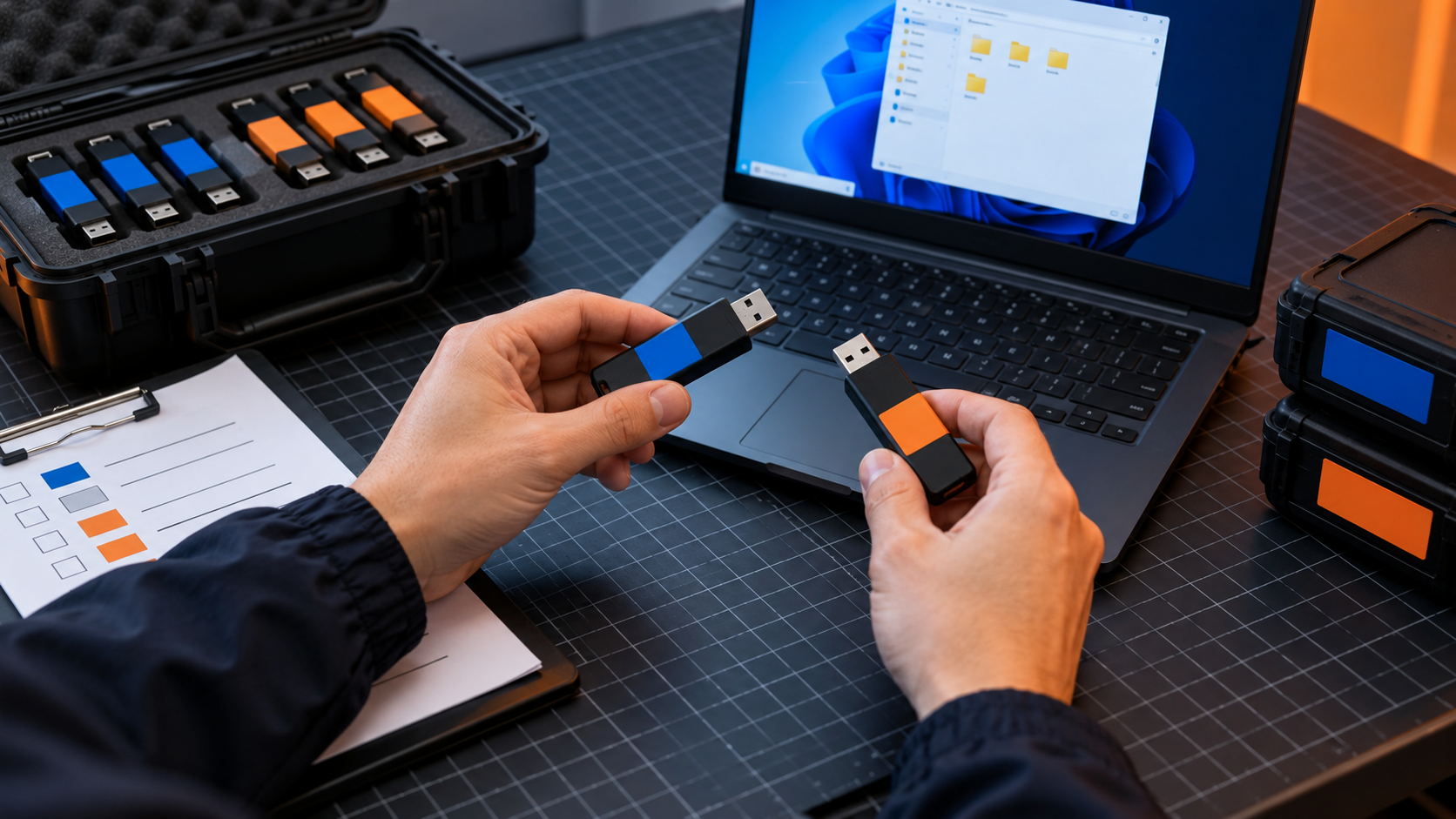
Build a deliberate delivery set
Create the delivery copy from an approved source, minimize it to the delivery request and separate it from originals. Clean copies should have stable filenames, checksums or counts where useful, and no hidden drafts, exports, thumbnails or unrelated metadata.
The source folder contains final delivery data, reviewer comments and working exports. The coordinator creates a new staging folder, copies only approved finals, removes embedded personal data, validates filenames and records a manifest before writing the delivery drive.
Run the control in five steps
- 01Map each delivery request to an approved source record.
- 02Copy only final, necessary files into a clean staging folder.
- 03Remove drafts, hidden files, personal data and unrelated metadata.
- 04Validate file counts, sizes and hashes where proportionate.
- 05Write the delivery copy once and preserve the signed manifest.
Preserve an accountable handoff record
Keep request ID, source owner, included filename, version, size, hash or count, reviewer, exclusion notes, staging path and write time. The manifest proves scope without reproducing sensitive content.
Stop and investigate when
- The delivery drive is populated directly from a broad working folder.
- Filename or version cannot be traced to the approved source.
- Temporary or hidden files appear after copying.
State what the control does not prove
Do not equate with hardware-encrypted drives or untested Mac/Android compatibility. Validate the device, recipient environment, secret channel, plaintext residue and recovery workflow separately.
Windows USB questions
Should the recipient receive the source folder?
Usually no. Prepare a minimized, reviewed delivery set that maps to the request.
Are checksums encryption?
No. A checksum helps detect change; it does not keep content confidential.
Sources for this decision
Links support specific control decisions and do not imply endorsement.